Machine Gnostics
AI Rooted in the Laws of Nature
Revolutionary Framework
Machine Gnostics represents the world's first comprehensive non-statistical machine learning framework, fundamentally challenging traditional AI by encoding the laws of nature directly into algorithms.
Foundation Principles
Scientific Foundation
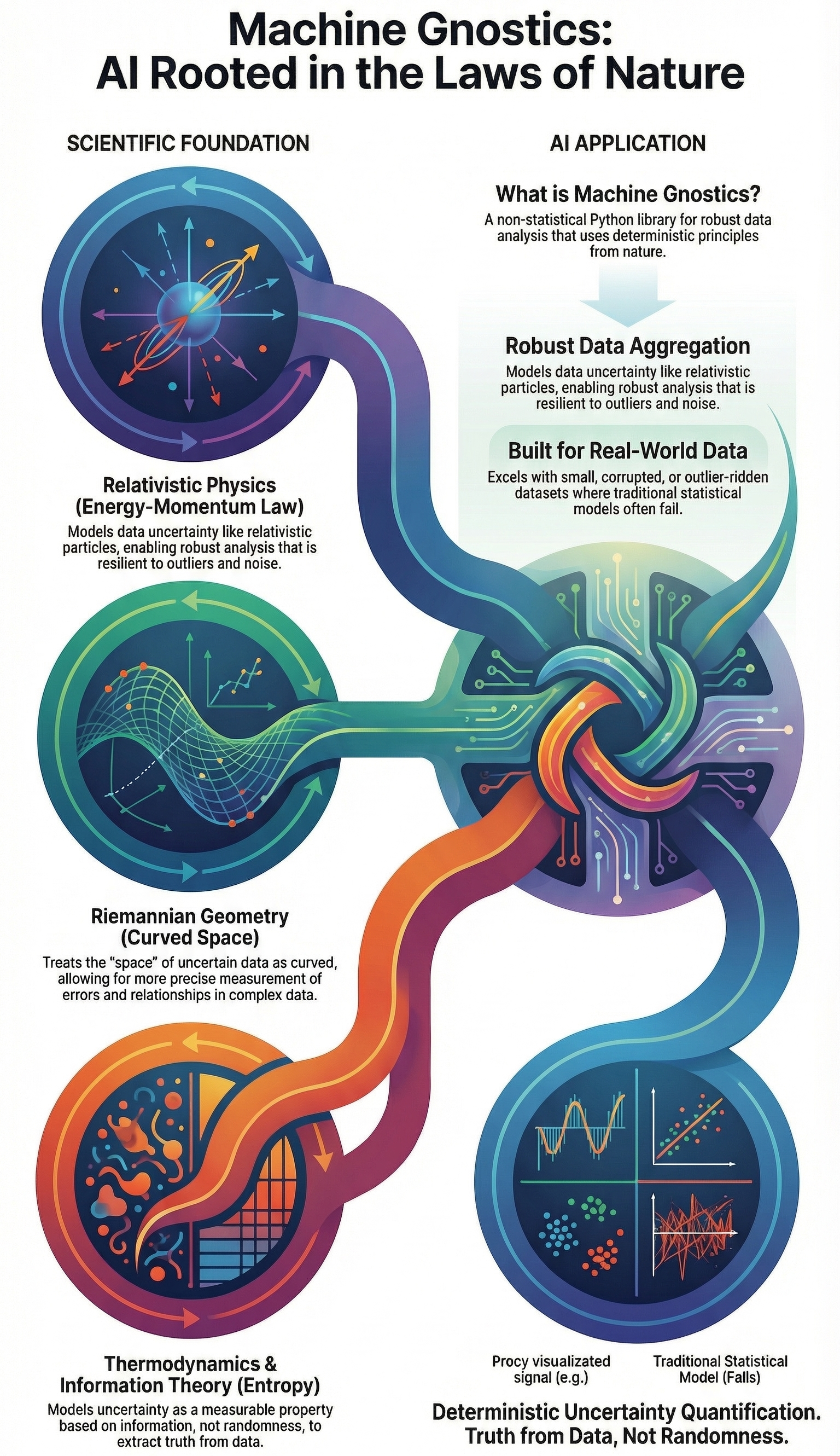
- Relativistic Physics - Energy-momentum law for data modeling
- Riemannian Geometry - Curved space for uncertainty quantification
- Thermodynamics - Information theory and entropy principles
- Universal Bounds - Mathematical constraints from nature
Non-Statistical Architecture
- Deterministic Principles - Data as measurable, material causes
- Small Data Excellence - Works regardless of dataset size
- Noise Resilience - Exceptional outlier and corruption resistance
- Truth Extraction - Data speaks for themselves
Core Capabilities
Robust Data Aggregation
Models data uncertainty like relativistic particles, enabling robust analysis that is resilient to outliers and noise.
Real-World Data Excellence
Excels with small, corrupted, or outlier-ridden datasets where traditional statistical models often fail.
Deterministic Uncertainty
Treats uncertainty as measurable property based on information, not randomness - truth from data, not assumptions.
Entropy Minimization
Minimizes entropy rather than squared error for model convergence - a unique trait that aligns with thermodynamic principles and information theory.
Technical Excellence
Mathematical Foundation
Machine Gnostics, based on Mathematical Gnostics, implements advanced mathematical concepts including vector bi-algebra, non-Euclidean geometries (Riemannian, Minkowskian), and quantification theory as foundational measurement science.
Small Data Mastery
Extracts truth from data regardless of sample size, delivering insights from minimal datasets without statistical assumptions.
Physical Constraint Recognition
Understands causality, physical constraints, and engineering principles embedded in data structures.
Exceptional Robustness
Delivers exceptional resilience against outliers, noise, and corrupted data through deterministic geometric modeling.
Universal Mathematical Bounds
Natural [0, ∞] constraints from physical laws ensure realistic, interpretable results in all applications.
MAGNET Deep Learning Framework
Next Generation AI
MAGNET (Machine Gnostics Networks) represents the next frontier - applying gnostic principles to neural network architectures for interpretable, robust deep learning models.
Physics-AI Integration
Seamlessly bridges traditional deep learning with physics-based modeling principles.
Reliable Standards
Establishes new benchmarks for trustworthy, nature-inspired artificial intelligence systems.
Open Source Leadership
Community Driven
Machine Gnostics is proudly open source, democratizing access to revolutionary AI methodologies and fostering global collaboration in advancing non-statistical machine learning.
Global Accessibility
Freely accessible codebase with comprehensive documentation, making advanced mathematical concepts available to researchers worldwide.
Industrial Integration
Seamless integration with standard ML workflows including MLflow, enabling easy adoption in existing data science pipelines.
Educational Mission
Building international network of researchers and practitioners while making advanced AI concepts accessible to broader audiences.
AI Paradigm Shift
Brings revolutionary change to AI by requiring a different lens to view data and data science problems, moving beyond traditional statistical thinking.
Scientific Impact
"Let data speak for themselves"
This core philosophy reflects Dr. Parmar's vision of AI that respects data individuality, leverages nature's laws, and operates effectively in the real world without idealized statistical assumptions. Machine Gnostics has gained recognition from leading researchers who have solved previously "unsolvable" problems using the framework.